Can Computers Think?
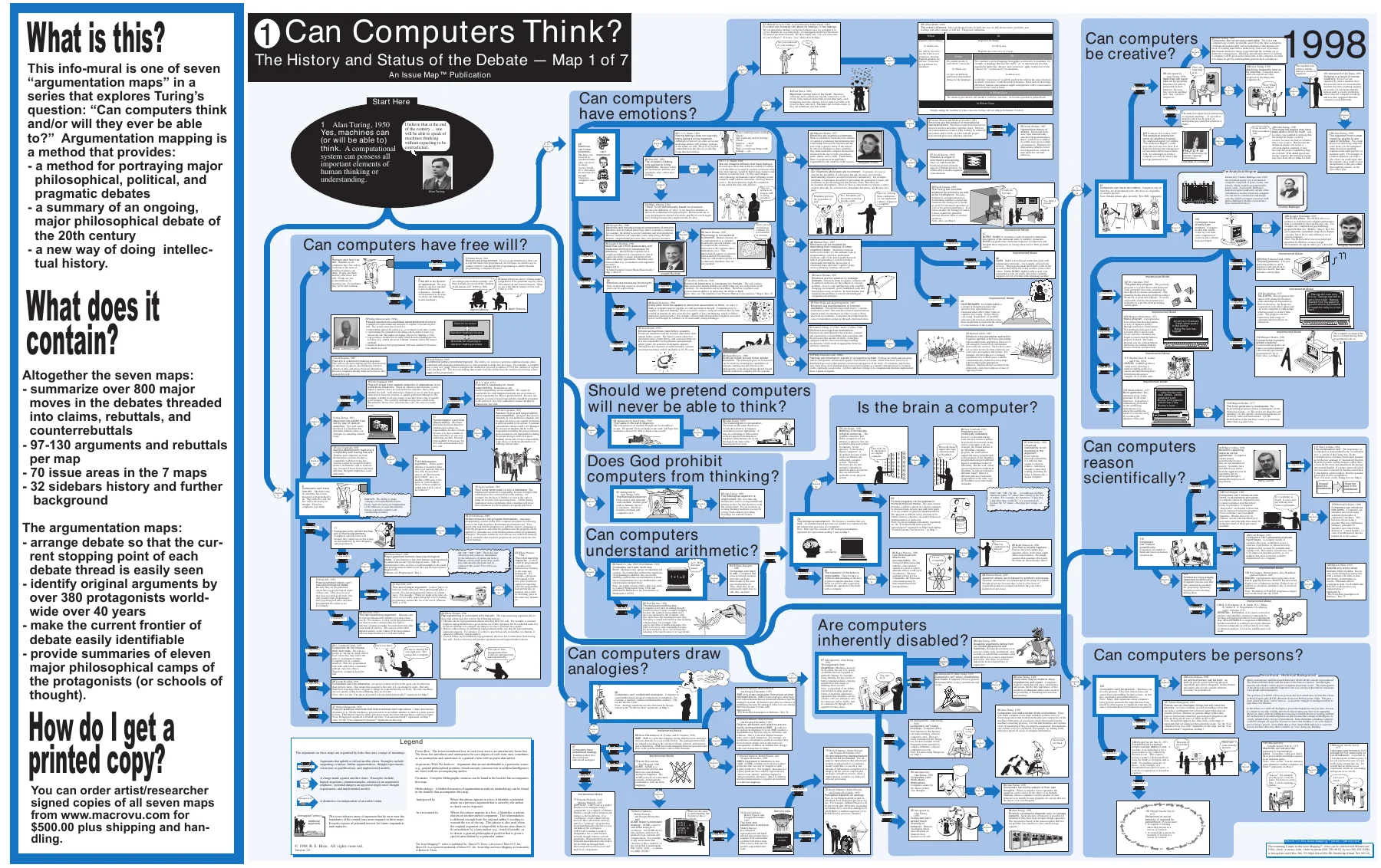
The broad architecture of the debate and its central branches.
Digital scholarship · 1998
Seven maps of the foundational debate over machine intelligence.
Created by Robert E. Horn, Jeff Yoshimi, Mark Deering, and Russ McBride. McBride authored Maps 1, 4, and 6.
The project
The seven “argumentation maps” organize more than 800 moves in the twentieth-century debate over whether computers can think—or ever will.
The project traces claims, objections, replies, conceptual divisions, and historical lines of influence across the Turing Test, physical symbol systems, the Chinese Room, connectionism and imagery, consciousness, and mathematical limits.
The maps were designed as durable intellectual artifacts: readers can locate the current stopping point of a debate thread, identify arguments across decades, and see how apparently separate questions depend on one another.
The original maps
Open any map in the deep-zoom viewer, download its original PDF, or access machine-extracted text.
The text files provide searchable access while structured scholarly transcriptions are developed.
Map 1 of 7
The broad map of the debate: consciousness, creativity, free will, arithmetic, analogy, scientific reasoning, personhood, disability, and the brain-as-computer question.
Map 2 of 7
Arguments over imitation, behavioral tests, species bias, the Loebner Prize, and whether passing or failing a Turing-style test is decisive.
Map 3 of 7
Whether thought can be represented symbolically, whether physical symbol systems resemble minds, and whether rules, bodies, and situated action matter.
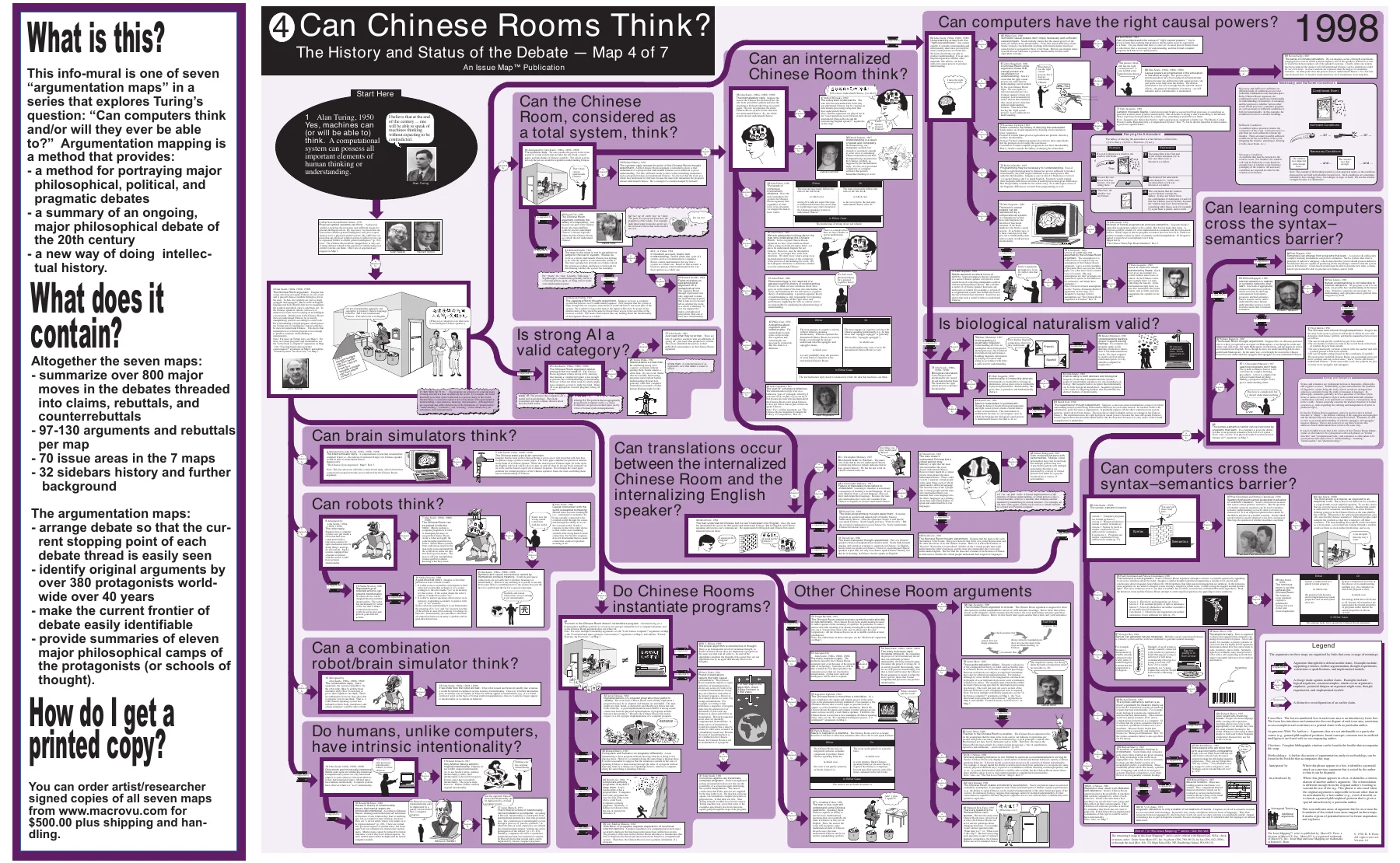
Map 4 of 7
The Chinese Room and its replies: systems, robots, brain simulators, syntax and semantics, intentionality, biological naturalism, and causal powers.
Map 5 of 7
Connectionist networks, systematicity, sub-symbolic representation, image psychology, imagery, and analogue properties of mental representation.
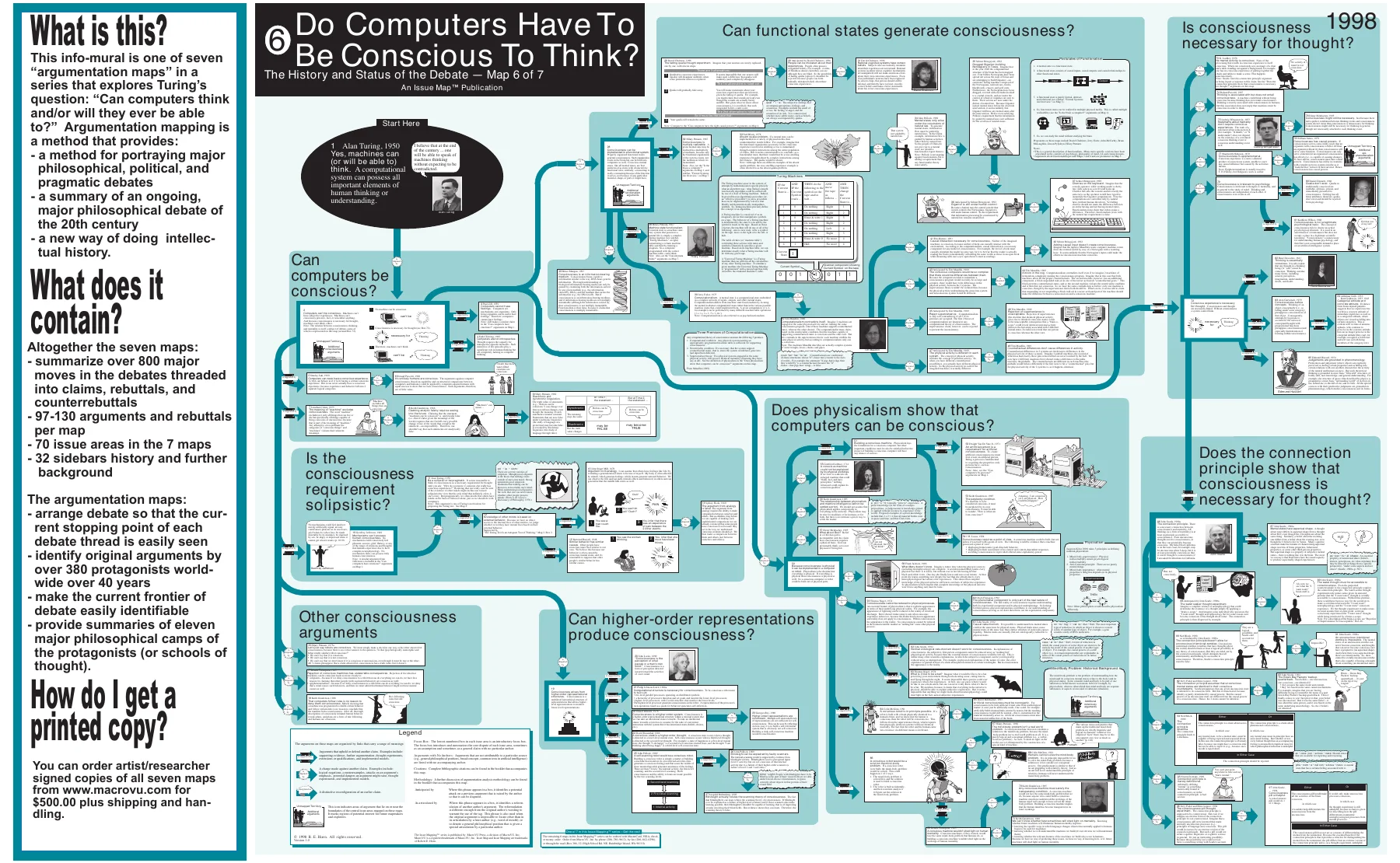
Map 6 of 7
Functional states, consciousness, physicalism, higher-order representation, connection principles, and whether thought requires conscious experience.
Map 7 of 7
Gödel and Lucas arguments, consistency, mechanistic philosophy, self-programming machines, mathematical insight, and the formal limits of automata.
How to read the maps
Each map begins with Alan Turing’s computationalist claim and follows a network of support, objection, counterargument, and reply.
→
Arrows connect a claim to support, dispute, qualification, or reply.
□
Argument boxes identify thinkers, dates, examples, and compact reconstructions.
↳
Large questions break into increasingly precise conceptual and empirical disputes.
?
Many pathways stop at an unresolved objection rather than a forced verdict.
1998 → 2026
The technologies changed dramatically. Many of the conceptual fault lines did not.
Machine learning, foundation models, large language models, multimodal systems, and agents have shifted what machines can do. Yet questions about representation, understanding, causal power, relevance, consciousness, and formal limitation remain central.
That continuity connects Can Computers Think? to Mean Articulation Machines: both ask which capabilities a system genuinely has, what those capabilities explain, and where fluent performance should not be mistaken for the form of judgment a task requires.
Citation, rights, and preservation
Horn, R. E., Yoshimi, J., Deering, M., & McBride, R. (1998). Can Computers Think? The History and Status of the Debate. MacroVU Press. Seven argument maps.
Copyright Robert E. Horn. Hosted on russmcbride.com with permission. The original maps are preserved without alteration; the historical ordering and pricing language visible within them is part of the original artifact.